
Last updated: 21 November 2026 · Written by Madhu M (B.E. Civil, former Land Surveyor, Revenue Department, Karnataka) · Serving Bengaluru
In short: An EWS certificate (official name: Income & Asset Certificate) lets you claim the 10% EWS reservation in Government of India jobs and central educational institutions. In Bengaluru, it is issued by the Karnataka Revenue Department through the Nadakacheri (Atalji Janasnehi Kendra). You can get it if your caste is not in the SC, ST or Central OBC list, your family’s gross income was below ₹8 lakh in the last financial year, and your family does not own land or property above the set limits.
Assistant Madhu helps Bengaluru families check eligibility, prepare papers, apply and follow up until the certificate is issued in the correct central format.
What is an EWS certificate?
EWS means Economically Weaker Section. Since February 2019, the Central Government keeps 10% of direct-recruitment posts for EWS candidates. To claim this, you must show an Income & Asset Certificate in the exact format prescribed by the Department of Personnel & Training (DoPT), called Annexure-I.
It is not a caste certificate. It is a certificate about your family’s money and property.
Where it is used: UPSC, SSC, railway, public sector bank and PSU jobs, other Government of India posts, and admissions to central educational institutions. Karnataka’s order of 31 July 2021 issues this certificate for Government of India posts and educational institutions. For Karnataka state recruitment or KCET seats, always read the notification you are applying for — it will say which certificate it accepts.
Who can get an EWS certificate in Karnataka?
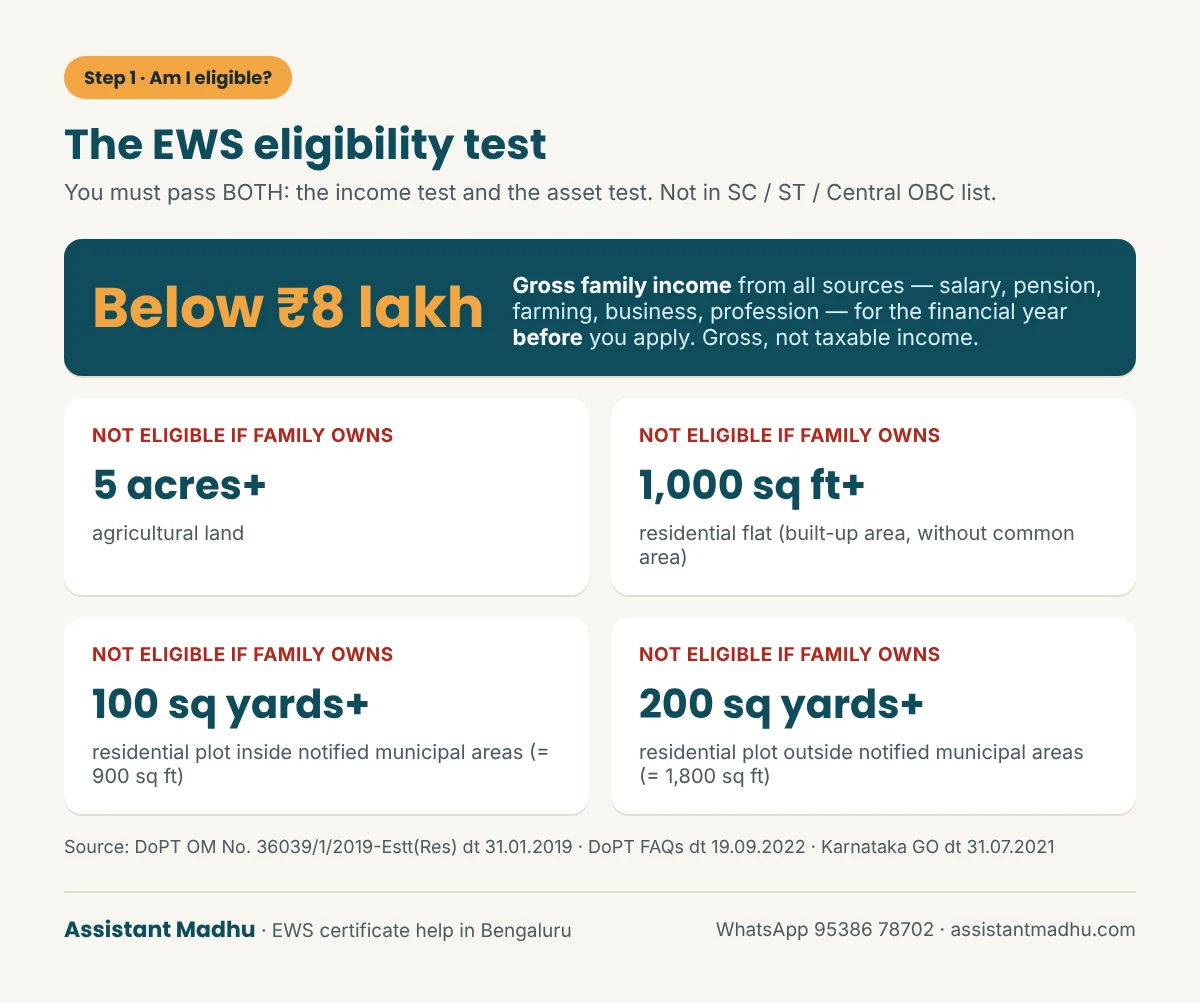
You must pass all three checks:
- Caste check: your caste is not in the SC list, ST list, or the Central OBC list for Karnataka.
- Income check: your family’s gross annual income from all sources was below ₹8,00,000 in the financial year before you apply. Salary, pension, family pension, farming, business and professional income are all added. It is gross income, not the “taxable income” after deductions.
- Asset check: your family does not own any of these:
- 5 acres or more of agricultural land
- A residential flat of 1,000 sq ft or more
- A residential plot of 100 sq yards (900 sq ft) or more in a notified municipal area
- A residential plot of 200 sq yards (1,800 sq ft) or more outside notified municipal areas
I am Category 2A / 3A / 3B in Karnataka. Can I still apply?
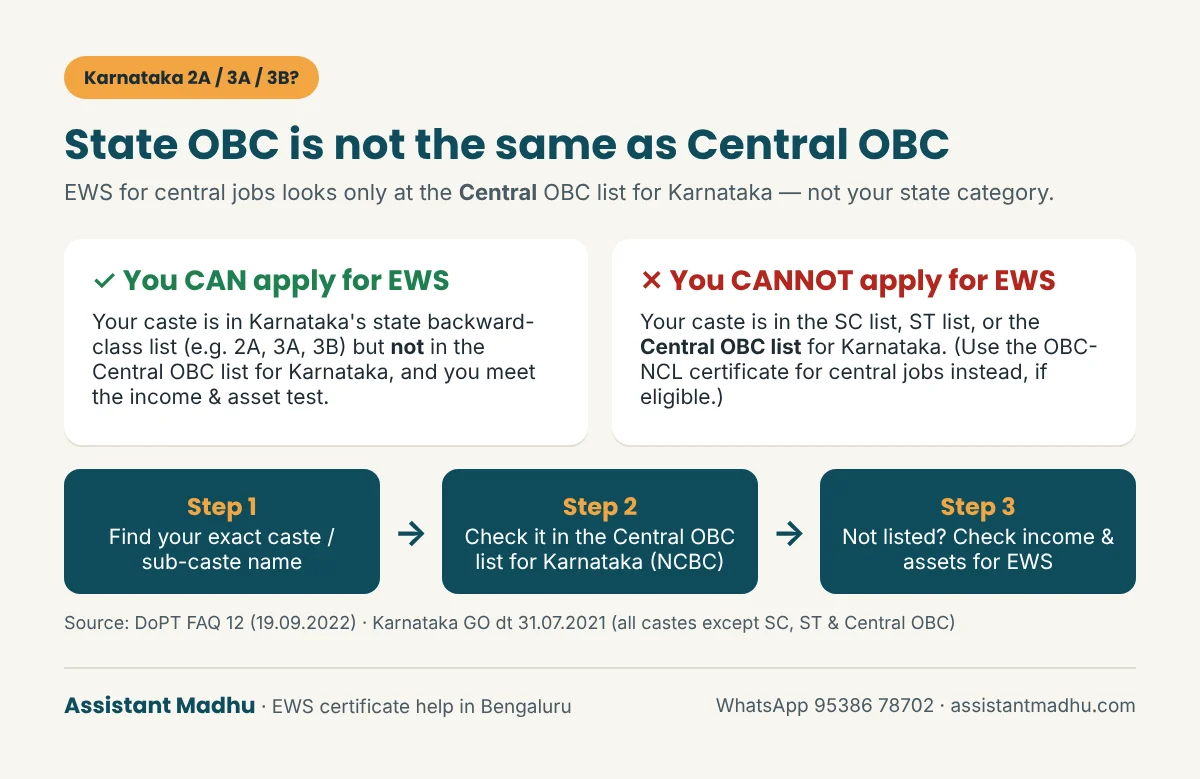
Possibly yes. This is the most common confusion in Karnataka. Karnataka has its own backward-class categories (1, 2A, 2B, 3A, 3B). The Central Government has a separate OBC list for Karnataka. They are not the same.
DoPT has clarified (FAQ No. 12, 19 September 2022) that if your community is OBC in the state list but not in the Central list, you can apply for an Income & Asset Certificate for central jobs. Karnataka’s Government Order of 31 July 2021 also allows all castes except SC, ST and Central OBC to get this certificate. (It cancelled the older 14 May 2019 order that had limited EWS to 144 listed castes.)
What matters is your exact caste or sub-caste name. For some communities, only certain sub-castes are in the Central list. Check your exact name in the Central OBC list for Karnataka before applying. If you are unsure, send it to us and we will check it with you.
Whose income and property is counted? (Family)
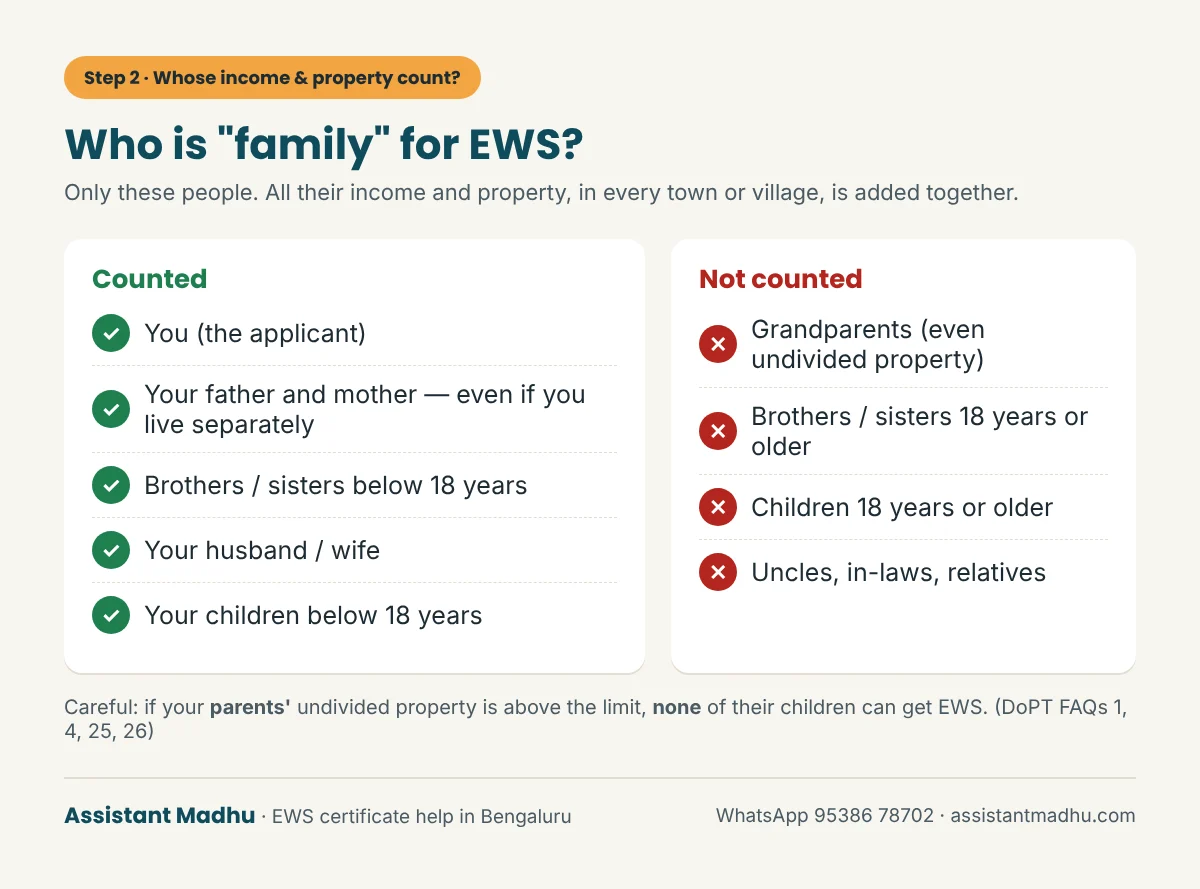
For EWS, “family” means only:
- You
- Your father and mother
- Your brothers and sisters below 18 years
- Your husband or wife
- Your children below 18 years
Points people miss:
- Your parents’ income and property are counted even if you live separately from them.
- Grandparents are not family, so their undivided property is not counted.
- Brothers, sisters and children who are 18 or older are not counted.
- Property in different towns, districts or states is added together. A site in Bengaluru plus land in your native village are both counted.
- If your parents’ undivided property is above the limit, none of their children can get EWS.
Bengaluru property check: does your site or flat pass?
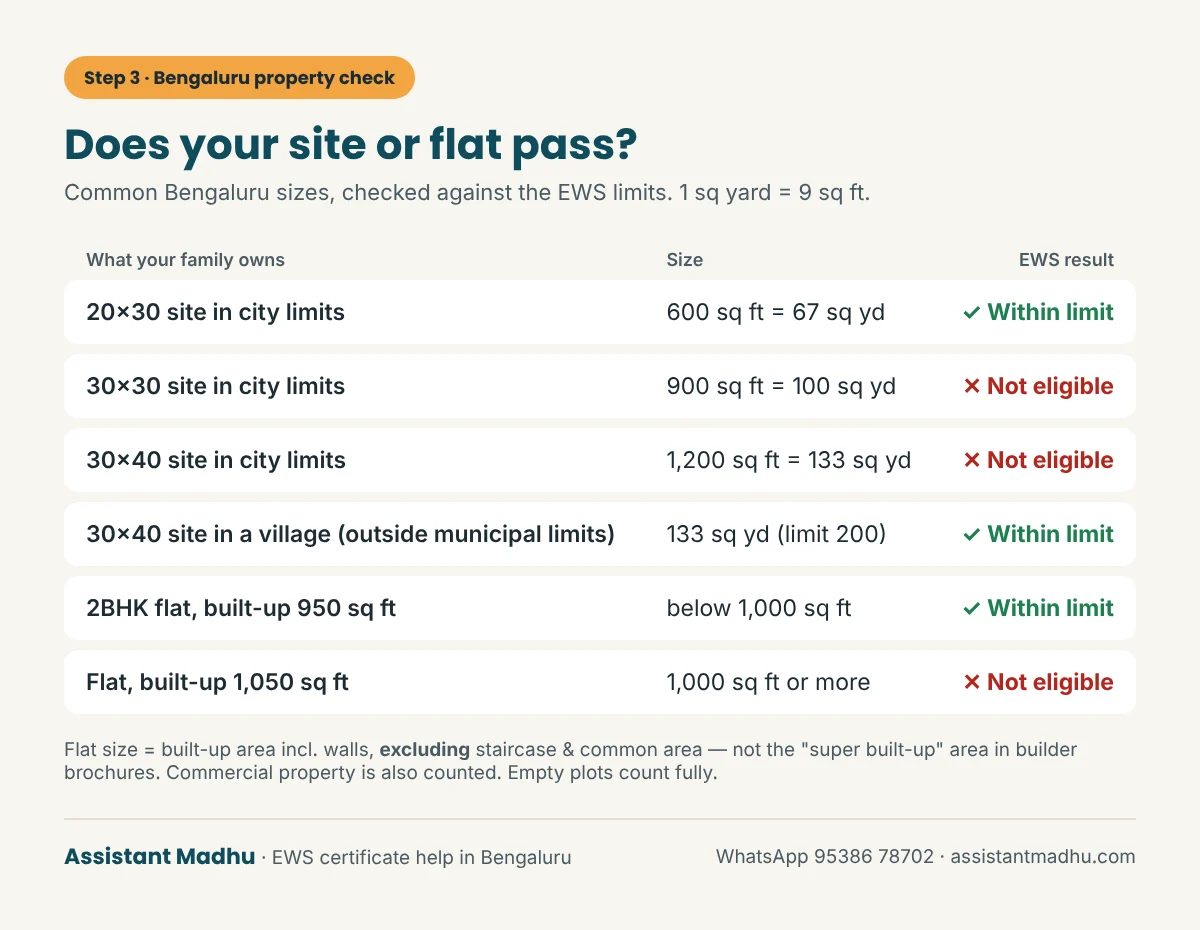
Most guides only quote “100 sq yards”. Here is what it means for common Bengaluru property sizes (1 sq yard = 9 sq ft):
| What the family owns | Size | EWS result |
|---|---|---|
| 20×30 site inside city limits | 600 sq ft (67 sq yd) | Within limit |
| 30×30 site inside city limits | 900 sq ft (100 sq yd) | Not eligible |
| 30×40 site inside city limits | 1,200 sq ft (133 sq yd) | Not eligible |
| 30×40 site in a village outside municipal limits | 133 sq yd (limit is 200) | Within limit |
| Flat with built-up area of 950 sq ft | Below 1,000 sq ft | Within limit |
| Flat with built-up area of 1,050 sq ft | 1,000 sq ft or more | Not eligible |
Flat size – which area? DoPT says take the total built-up area of the flat including walls and pillars, but excluding staircase and common areas. Builder documents in Bengaluru often show “super built-up area”, which includes common areas. A flat sold as “1,150 sq ft super built-up” may be below 1,000 sq ft built-up. Check your sale deed or approved plan.
Also counted: commercial property (shops etc.) is treated like residential property; an empty plot counts fully even if no house is built; for a house on farm land, the house plot is residential and the rest is agricultural.
As a civil engineer and former Revenue Department land surveyor, I can read your RTC, khata, sale deed or approved plan and tell you whether your family’s property is within the limit before you apply.
Documents to keep ready
- Aadhaar card of the applicant (and ration card, if any, to show family members)
- Address proof of your permanent address in Bengaluru
- Income proof of every earning family member — salary slips / Form-16, pension slips, business or farm income details
- PAN card, Form-16 and Income Tax Returns of family members, if available
- If PAN / Form-16 / ITR are not available in the family: a notarised affidavit saying so (Karnataka’s order of 31 July 2021 asks officers to check these or take an affidavit)
- Property details: RTC / pahani for farm land, khata or sale deed for sites, flats and houses — or a declaration that the family owns no property
- Caste details of the applicant
- Recent passport-size photograph
The exact list can change at the Nadakacheri. We confirm the current list for your case before you apply.
How to get an EWS certificate in Bengaluru
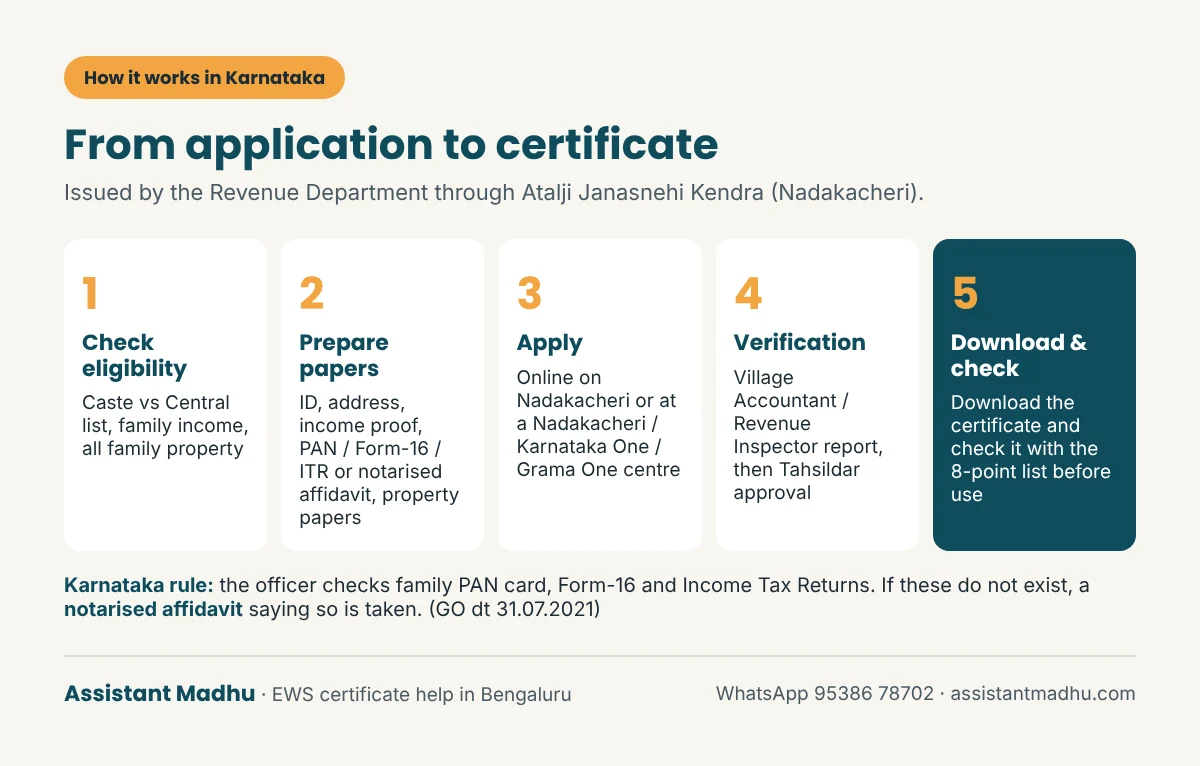
- Check eligibility first — caste against the Central list, family income, and all family property in every place.
- Prepare documents for every family member who counts.
- Apply for the “Income and Asset Certificate (EWS)” on the Nadakacheri portal, or at a Nadakacheri (Atalji Janasnehi Kendra), Karnataka One or Grama One centre. Apply in the taluk of your permanent address.
- Verification — revenue officials check your details and the Tahsildar approves.
- Download and check the certificate with the 8-point checklist below before you upload it anywhere.
The time taken to issue is fixed by the State, not by DoPT. Delays usually happen when income or property details are unclear. Clear papers = faster certificate.
Timing: the financial-year rule (very important)
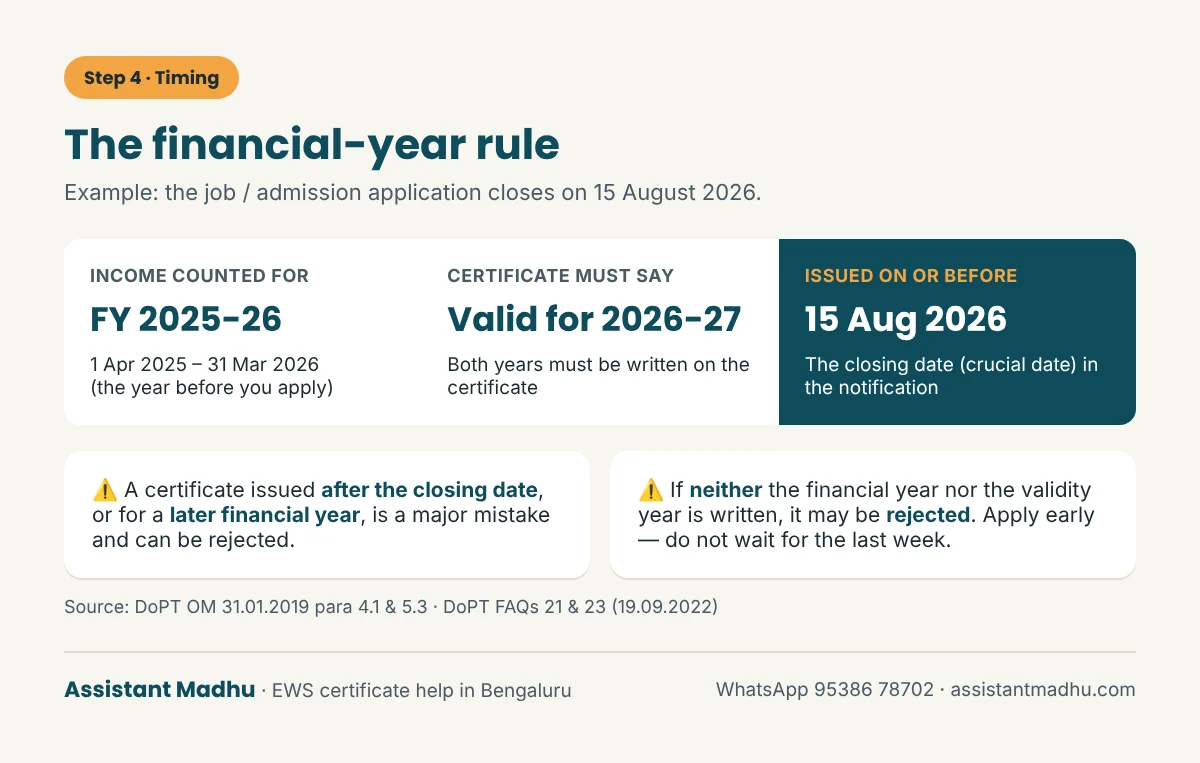
Income is counted for the financial year before the year of application. Example from DoPT: if the job application closes in August, income is for the previous April–March year, and the certificate is “valid for” the current year.
- Application closes on 15 August 2026 → income for FY 2025-26 → certificate valid for 2026-27.
- The certificate must be issued on or before the closing date (the “crucial date”) mentioned in the notification.
- A certificate issued after the closing date, or for a later financial year, is treated as a major discrepancy and can be rejected.
- An EWS certificate is tied to one financial year. For a new recruitment year you usually need a fresh one.
8-point check before you upload to UPSC, SSC, IIT or a bank
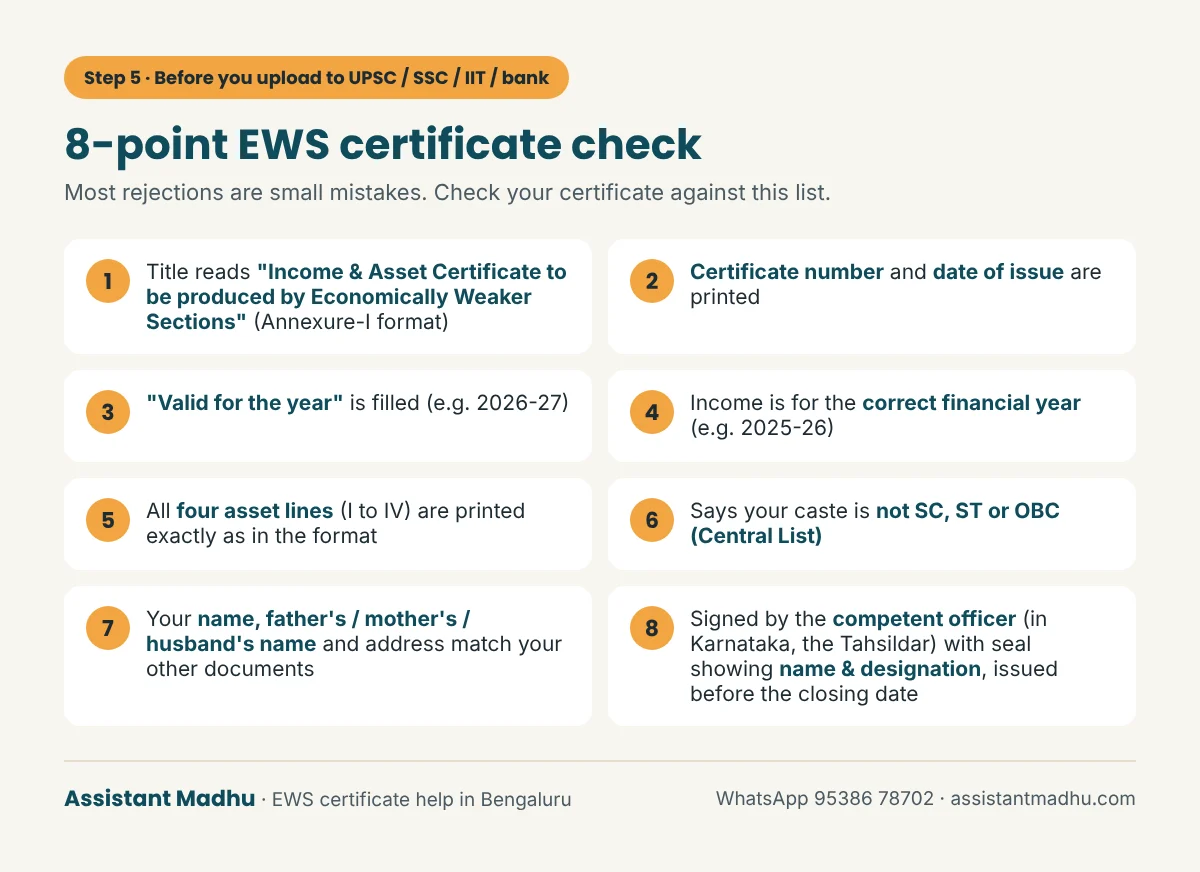
- The heading reads “Income & Asset Certificate to be produced by Economically Weaker Sections” (Annexure-I format). States cannot use a different format for central jobs.
- Certificate number and date of issue are printed.
- “Valid for the year” is filled in.
- Income is shown for the correct financial year.
- All four asset conditions (I to IV) are printed exactly as in the format.
- It says your caste is not recognised as SC, ST or OBC (Central List).
- Your name, parent’s/husband’s name and address match your other documents.
- It carries the signature and seal of the competent officer with name and designation, and is dated on or before the closing date.
Small mistakes on this list are the most common reason EWS claims run into trouble during document verification. If anything is missing, get it corrected at the issuing office before the closing date.
Common mistakes we help you avoid
- Assuming “I am 3A/3B, so I can’t apply” — without checking the Central list.
- Showing take-home or taxable income instead of gross income.
- Forgetting a parent’s pension, farm income or rent.
- Forgetting village land or a site in another town (all property is added).
- Using “super built-up area” for a flat.
- Getting the certificate for the wrong financial year, or after the closing date.
- Uploading an old or state-format certificate for a central job.
- Giving wrong details — if a certificate is later found false, the appointment can be terminated and legal action taken.
How Assistant Madhu helps
I am Madhu M, a civil engineer (B.E. Civil) and former Land Surveyor in Karnataka’s Revenue Department. I help Bengaluru families with government-office work — on the ground, not just with advice.
- Eligibility check: caste vs Central list, family income, property size
- Reading your property papers (RTC, khata, sale deed, plan) to confirm the asset limits
- Preparing the application, affidavit and supporting documents
- Filing at the Nadakacheri and following up until the certificate is issued
- Checking the final certificate against the central format before you upload it
- Correction help if a certificate has mistakes
Service area: Bengaluru only. Work by appointment — please message first.
Frequently asked questions
What is the income limit for an EWS certificate?
Your family’s gross annual income from all sources must be below ₹8 lakh for the financial year before you apply. Salary, pension, farming, business and professional income are all included.
Is the ₹8 lakh limit on gross salary or taxable income?
Gross. DoPT says it is always gross salary / gross income. For example, gross salary of ₹10 lakh with taxable income of ₹6 lakh is not eligible.
Is pension counted in family income?
Yes. Monthly pension and family pension are counted.
Can a Karnataka 2A, 3A or 3B candidate get an EWS certificate?
Yes, if their exact caste is not in the Central OBC list for Karnataka and they meet the income and asset test. Karnataka’s 31 July 2021 order allows all castes except SC, ST and Central OBC. If your caste is in the Central OBC list, you cannot claim EWS for central jobs.
Is my grandparents’ property counted?
No. Grandparents are not part of the “family” for EWS, even if their property is not yet divided.
I live separately from my parents. Is their income counted?
Yes. Parents’ income and property are counted even if you live separately from them.
Is a 30×40 site in Bengaluru allowed for EWS?
A 30×40 site is 1,200 sq ft, which is about 133 sq yards. Inside notified municipal limits the limit is under 100 sq yards, so the family would not be eligible. Outside notified municipal limits the limit is under 200 sq yards, so it would be within the limit.
How is flat size measured for EWS?
Total built-up area of the flat, including walls and pillars, but excluding staircase and common areas. Not the “super built-up” area.
How long is an EWS certificate valid?
It is linked to one financial year. The certificate shows income for the previous financial year and is “valid for” the current year. It must be issued on or before the closing date of the post you apply for.
Is EWS valid for 3 years?
No. For central jobs, the EWS Income & Asset Certificate is tied to one financial year. You usually need a new certificate for a new year’s recruitment.
Do EWS candidates get age relaxation?
For central government posts, no. DoPT says EWS candidates follow the same age limit and number of attempts as General candidates.
Who issues the EWS certificate in Bengaluru?
The Karnataka Revenue Department, through the Nadakacheri (Atalji Janasnehi Kendra). It is approved by the Tahsildar of your taluk. Apply where your permanent address is.
Is the EWS certificate the same as EWS housing (BDA / PMAY)?
No. The EWS Income & Asset Certificate is for job and admission reservation. Housing schemes have their own EWS rules and income limits. Check the housing scheme’s own notification.
What if my EWS certificate has a mistake?
Get it corrected at the issuing office before the closing date of your application. If only the “valid for the year” box is blank but the financial year is correctly shown, recruiters may refer it back for confirmation. If neither year is mentioned, it can be rejected.
ಕನ್ನಡದಲ್ಲಿ ಸಂಕ್ಷಿಪ್ತ ಮಾಹಿತಿ (EWS ಪ್ರಮಾಣಪತ್ರ – ಬೆಂಗಳೂರು)
EWS ಪ್ರಮಾಣಪತ್ರ ಎಂದರೆ “ಆದಾಯ ಮತ್ತು ಸ್ವತ್ತು ಪ್ರಮಾಣಪತ್ರ”. ಕೇಂದ್ರ ಸರ್ಕಾರದ ಹುದ್ದೆಗಳು ಮತ್ತು ಕೇಂದ್ರ ಶಿಕ್ಷಣ ಸಂಸ್ಥೆಗಳಲ್ಲಿ 10% EWS ಮೀಸಲಾತಿ ಪಡೆಯಲು ಇದು ಬೇಕು.
- ನಿಮ್ಮ ಜಾತಿ SC, ST ಅಥವಾ ಕೇಂದ್ರ OBC ಪಟ್ಟಿಯಲ್ಲಿ ಇರಬಾರದು. ರಾಜ್ಯದ 2A/3A/3B ಪ್ರವರ್ಗದಲ್ಲಿದ್ದರೂ, ಕೇಂದ್ರ ಪಟ್ಟಿಯಲ್ಲಿ ಇಲ್ಲದಿದ್ದರೆ ಅರ್ಜಿ ಹಾಕಬಹುದು.
- ಕುಟುಂಬದ ಒಟ್ಟು (gross) ವಾರ್ಷಿಕ ಆದಾಯ ₹8 ಲಕ್ಷಕ್ಕಿಂತ ಕಡಿಮೆ ಇರಬೇಕು.
- ಕುಟುಂಬದಲ್ಲಿ 5 ಎಕರೆ ಅಥವಾ ಹೆಚ್ಚು ಕೃಷಿ ಜಮೀನು, 1,000 ಚ.ಅಡಿ ಅಥವಾ ಹೆಚ್ಚಿನ ಫ್ಲಾಟ್, ನಗರ ಪ್ರದೇಶದಲ್ಲಿ 100 ಚ.ಗಜ (900 ಚ.ಅಡಿ) ಅಥವಾ ಹೆಚ್ಚಿನ ನಿವೇಶನ ಇರಬಾರದು.
- ಕುಟುಂಬ ಎಂದರೆ: ನೀವು, ತಂದೆ-ತಾಯಿ, 18 ವರ್ಷದೊಳಗಿನ ಸಹೋದರ-ಸಹೋದರಿಯರು, ಪತಿ/ಪತ್ನಿ ಮತ್ತು 18 ವರ್ಷದೊಳಗಿನ ಮಕ್ಕಳು.
- ಪ್ರಮಾಣಪತ್ರವನ್ನು ನಾಡಕಚೇರಿ (ಅಟಲ್ಜೀ ಜನಸ್ನೇಹಿ ಕೇಂದ್ರ) ಮೂಲಕ ತಹಶೀಲ್ದಾರ್ ನೀಡುತ್ತಾರೆ. ಅರ್ಜಿಯ ಕೊನೆಯ ದಿನಾಂಕದೊಳಗೆ ಪ್ರಮಾಣಪತ್ರ ಪಡೆಯಿರಿ.
ಬೆಂಗಳೂರಿನಲ್ಲಿ EWS ಪ್ರಮಾಣಪತ್ರಕ್ಕೆ ಸಹಾಯ ಬೇಕೇ? ವಾಟ್ಸಾಪ್ ಮಾಡಿ: 95386 78702
Official sources used on this page
- DoPT Office Memorandum No. 36039/1/2019-Estt.(Res), dated 31.01.2019 – EWS reservation, income and asset test, family definition, Annexure-I format
- DoPT O.M. No. 43011/11/2022-Estt.(Res-II), dated 19.09.2022 – Frequently Asked Questions on EWS reservation
- DoPT O.M. No. 36039/1/2019-Estt.(Res.-II), dated 15.03.2024 – States to decide authorities competent to issue Income & Asset Certificates
- Government of Karnataka Order No. ಹಿಂವಕ 75 ಬಿಸಿಎ 2019, dated 31.07.2021 – Income & Asset Certificate for all castes except SC, ST and Central OBC; withdrawal of order dated 14.05.2019
This page explains government rules in simple words for general guidance. Assistant Madhu is a private service provider and is not a government office. Final decisions are made by the issuing authority.